
Research
Advancing IBD Care Through Research and Clinical Trials
The CHUM IBD Centre is advancing inflammatory bowel disease (IBD) research in Montreal through clinical trials and investigator-initiated studies focused on improving diagnosis, treatment and patient care. Led by Dr. Robert Battat, our research team gives eligible patients access to emerging therapies while investigating new approaches to understanding, monitoring and treating IBD.
At any given time, the Centre typically oversees at least six active clinical trials, including multi-centre international studies in Crohn’s disease and ulcerative colitis. Our academic research also explores biomarkers, personalized treatment strategies and other approaches that could improve outcomes for people living with IBD.
Interested in participating in IBD research? Learn more about our clinical trials and academic studies below, or contact our research team to find out about current opportunities.
Clinical Trials
VICTRIVA
(combined vedolizumab and upadacitinib)
Primary objective
Compare the effect of vedolizumab + upadacitinib combination therapy vs vedolizumab alone
Population
Adults with moderately to severely active Crohn’s disease
Induction phase (12 weeks)
- Group 1: Vedolizumab + upadacitinib
- Group 2: Vedolizumab + placebo
- Maintenance phase (40 weeks): Vedolizumab alone for responders
Number of participants
Approximately 396
Total study duration
70 weeks
Study type
Multi-centre, international trial
MK-7240-001
(tulisokibart)
Primary objective
Assess the efficacy and safety of tulisokibart in patients with moderately to severely active ulcerative colitis
Population
Adults with moderately to severely active ulcerative colitis
Study structure
- Study 1: Induction (12 weeks) + maintenance (up to 52 weeks)
- Study 2: Induction only (12 weeks)
- Long-term extension: up to Week 156 for both studies
Primary efficacy endpoint
Clinical remission based on modified Mayo score at Week 12 (and Week 52 for Study 1)
Treatment regimen
- Tulisokibart IV and SC
- Placebo IV and SC
Number of participants
Approximately 1020
- ~ 720 in Study 1
- ~ 300 in Study 2
- ~ 50% previously exposed to advanced therapies (anti-TNF, anti-integrins, anti IL-23, anti-IL-12/23, JAK inhibitors, S1PR modulators)
- < 30% of pretreated patients will have failed ≥ advanced therapies
Total study duration
Up to 156 weeks
Study type
Multi-centre, international trial
MK-7240-008
(tulisikubart)
Primary objective
Assess the efficacy and safety of tulisokibart in patients with moderately to severely active Crohn’s disease
Population
Adults with moderately to severely active Crohn’s disease
Study structure
- Study 1: Induction (12 weeks) + maintenance (up to 52 weeks)
- Study 2: Induction only (12 weeks)
- Long-term extension: possible up to Week 156 for both studies
Treatment regimen
- Tulisokibart IV and SC
- Placebo IV and SC
Number of participants
Approximately 1200
- ~ 720 in Study 1
- ~ 480 in Study 2
- Up to 65% with prior exposure to advanced therapies (anti-TNF, anti-integrin, anti-IL-23, anti-IL-12/23, JAK inhibitors)
- Maximum 30% of patients with failure of ≥3 advanced therapies
Total study duration
Up to 156 weeks
Study type
Multi-centre, international trial
ICONIC-UC
(icotrokinra)
Sponsor
Janssen Research & Development, LLC
Primary objective
Evaluate the efficacy, safety and tolerability of oral icotrokinra
Population
Adults with moderately to severely ulcerative colitis
Eligibility criteria
- Diagnosis of UC established at least 12 weeks before screening
- Moderately to severely active UC based on endoscopic score
- Participants had either not responded well to, or were unable to tolerate, standard treatments and had not previously received advanced therapies (ADT-naïve), or had not responded to (primary or secondary nonresponse) or were unable to tolerate advanced therapies (biologics and/or advanced oral agents) used to treat UC (ADT-inadequate responders [IR])
Study structure
- Induction (12 weeks) + maintenance (up to 52 weeks)
- Long-term extension
Treatment regimen
- Icotrokinra Per Os
- Placebo Per Os
Number of participants
Approximately 882
Study type
Multi-centre, international trial
ICONIC-CD
(icotrokinra)
Sponsor
Janssen Research & Development, LLC
Primary objective
Evaluate the efficacy, safety and tolerability of oral icotrokinra
Population
Adults with moderately to severely active Crohn’s disease
Eligibility criteria
- Male or female aged 18-75 years old with diagnosis of CD for at least 30 days
- Confirmed diagnosis of moderately to severely active CD assessed endoscopic score
- Moderately to severely active CD based on endoscopic score
- Participants had either not responded well to, or were unable to tolerate, standard treatments and had not previously received advanced therapies (ADT-naïve), or had not responded to (primary or secondary nonresponse) or were unable to tolerate advanced therapies (biologics and/or advanced oral agents) used to treat CD (ADT-inadequate responders [IR])
Study structure
- Induction (12 weeks) + maintenance (up to 52 weeks)
- Long-term extension
Treatment regimen
- Icotrokinra Per Os
- Placebo Per Os
Number of participants
Approximately 882
Study type
Multi-centre, international trial
TAK-279-CD-2001
(zasocitinib)
Sponsor
Takeda Development Center Americas, Inc.
Primary objective
Evaluate the efficacy and safety of oral TAK-279 in subjects with moderately to severely active CD
Population
Adults with moderately to severely active Crohn’s disease
Eligibility criteria
- Diagnosis of Crohn’s disease established at least 12 weeks before screening
- Moderately to severely active Crohn’s disease based on endoscopic score
- Participants must have had an inadequate response to, loss of response to, or intolerance to at least one or more conventional, biologic or advanced therapy for CD
Study structure
- Induction (12 weeks)
- Maintenance (up to 52 weeks)
Treatment regimen
- TAK-279 (or Zasocitinib) Per Os
- Placebo Per Os
Number of participants
Approximately 268
Study type
Multi-centre, international trial
Clinical Trials Accepting Participants
VICTRIVA
Vedolizumab and upadacitinib combination therapy for the treatment of patients with active Crohn’s disease
Duration: Up to 24 weeks
Recruitment: In progress
Age: 18 to 55 years old
Academic Studies
PREDICT-OR
Pharmacokinetic and pharmacodynamics of therapies, non-inflammatory surgical complications and predictive biomarkers in IBD and post-operative Crohn’s disease study
Objectives
The primary objective of the study is to estimate the incidence of post-operative recurrence in patients who have received adequate exposure to approved biologic therapies.
The secondary objective of the study is to determine whether response to certain drugs or recurrence of disease after surgery is related to genetic factors in patients with Crohn’s disease or ulcerative colitis, and whether biomarkers can predict response to treatment or recurrence of disease after surgery.
We aim to perform multi-omic analyses to provide personalized biomarker testing to predict treatment response and to understand who will not recur after a surgery.
IGenoMed
Identifying biomarkers of response to molecularly targeted therapies (MTT) in IBD
Primary objective
- To identify biological determinants of response or non-response to targeted therapies
We aim to find biomarkers to provide personalized diagnostics to predict who will respond to treatment.
Population
- Diagnosis of IBD according to the investigator’s standard medical practice
- Subjects at the stage of initiating treatment with an advanced therapy and/or biologic therapy for IBD
Participants
500 patients
Total duration of participation
Up to 60 weeks
PATHFINDER
A pragmatic, active-comparator, parallel-group, randomized trial to evaluate the optimal first-line treatment strategy for Moderately to severely active ilealdominant Crohn’s disease
Primary objective
Compare non-inferiority of antiintegrin therapy to anti-TNFα and anti-IL23 biologics as first-line treatment for achieving 1-year corticosteroid-free endoscopic remission
Population
Participants who have not previously received biologic treatments for Crohn’s disease
Participants
297 patients
Total duration of participation
12 months
EFFECT-UC
Effectiveness of etrasimod on disease activity and patient-reported outcomes in ulcerative colitis
Primary objective
Evaluate the effectiveness of etrasimod therapy in patients with moderate to severe ulcerative colitis
Population
Patients with a confirmed diagnosis of moderate to severe ulcerative colitis who are going to receive etrasimod
Participants
Approximately 520 patients
Total duration of participation
Approximately 52 weeks
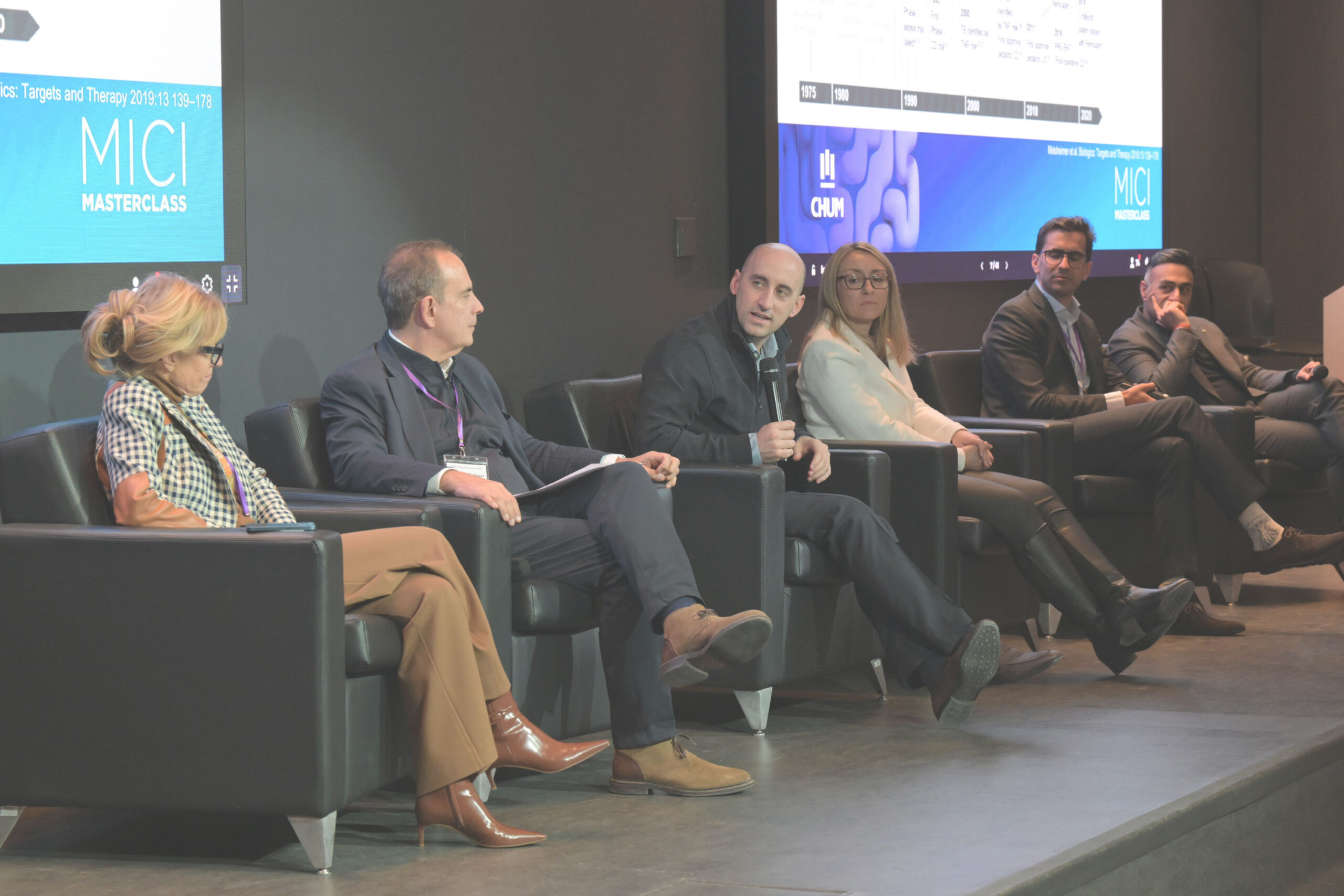
Our research explores IBD as a whole-life condition, from its physical burden to its impact on work, relationships and wellbeing.